
Published on March 15, 2026
AI Video Production Is Not a Tool Problem. It Is a Workflow Problem
AI video production is not only about choosing the right tool. Brands need a structured workflow that connects strategy, creative direction and execution.
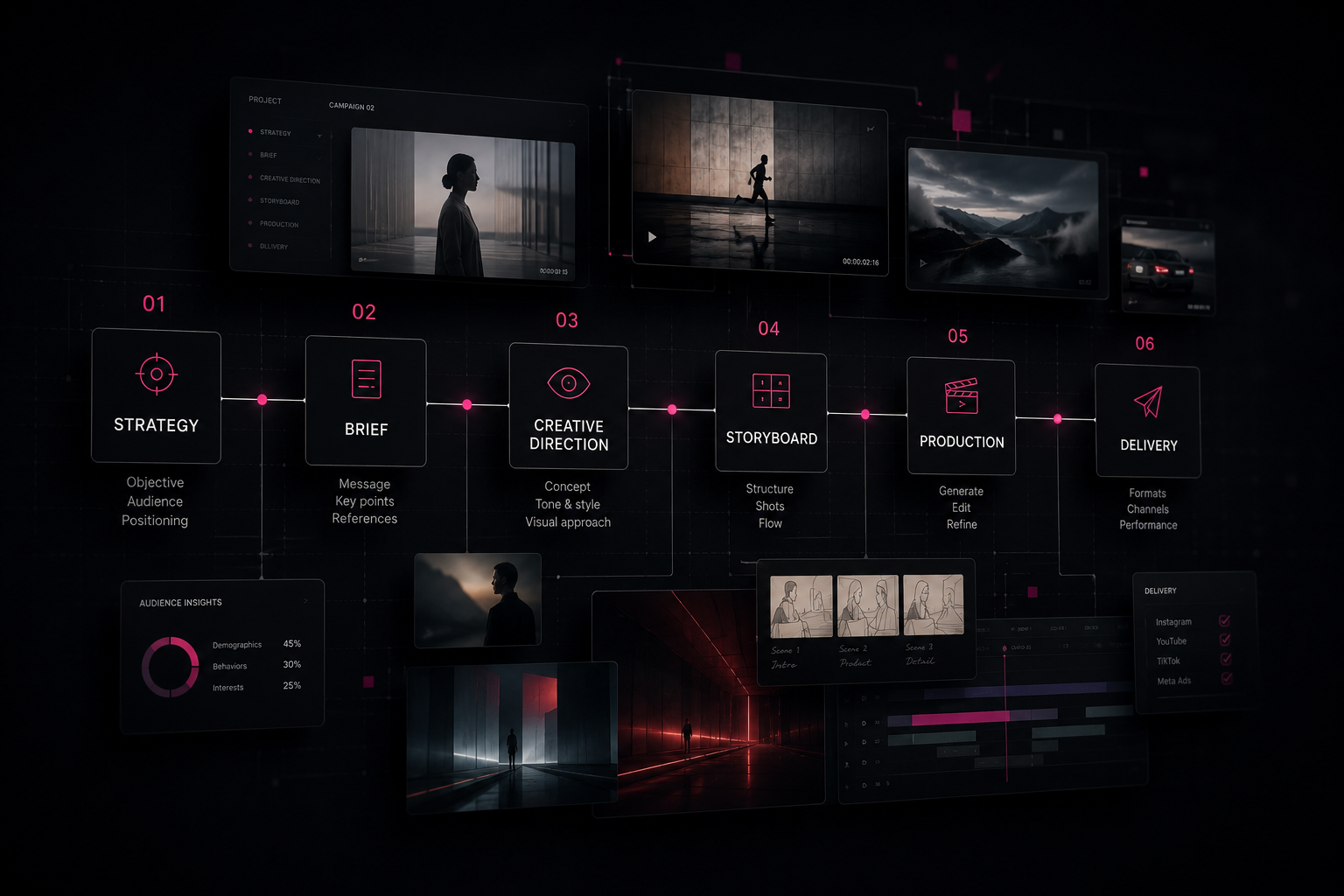
AI video production has a misunderstanding problem
Most conversations about AI video production start in the wrong place.
They begin with tools.
Which model is better? Which generator is more realistic? Which platform can create longer shots? Which tool produces cleaner motion, better faces, sharper product shots or more cinematic lighting?
These questions matter. But they are not the real problem.
The real problem is not whether a brand can generate a video with AI. The real problem is whether that video is strategically correct, creatively coherent, visually consistent and useful for a real commercial objective.
AI video production is not just a tool problem. It is a workflow problem.
A brand does not need more isolated outputs. It needs a way to turn strategy, positioning, creative direction, production decisions and final delivery into a controlled system.
That is where most AI video work breaks.
Not at generation. At structure.
Why tools alone do not solve production
AI tools are powerful because they reduce friction. They make it possible to generate visuals, scenes, voices, music, scripts, references and iterations much faster than before.
But speed is not the same as direction.
A tool can generate an image. It cannot decide what a brand should say.
A tool can produce a video clip. It cannot define whether the piece should build awareness, explain a product, create desire, establish authority or drive conversion.
A tool can create variations. It cannot guarantee that those variations follow the same strategic logic, tone of voice, visual identity or campaign objective.
This creates a paradox: AI makes production faster, but without a workflow it can also make production more chaotic.
More options. More versions. More experiments. More visual noise.
But not necessarily better communication.
The hidden cost of unstructured AI production
When AI video production is handled only as tool usage, several problems appear quickly.
The first is inconsistency. Each output may look impressive in isolation, but the brand becomes unstable across pieces. One video feels premium, the next one playful, the next one generic, the next one visually disconnected.
The second is weak decision-making. The team spends too much time choosing between outputs instead of defining the criteria that should guide those outputs in the first place.
The third is creative drift. Without a clear brief, the production moves wherever the tool performs better, not necessarily where the brand needs to go.
The fourth is operational fatigue. What seemed fast becomes messy: prompts, references, regenerations, exports, approvals, edits, feedback loops and unclear ownership.
The fifth is generic output. When there is no strong strategic layer, AI tends to produce content that could belong to almost any brand in the same category.
The problem is not the technology. The problem is the absence of a system around the technology.
Traditional production has structure, but too much weight
Traditional video production solves some of these problems through process.
There is a brief. There is preproduction. There is a director. There is a production plan. There are scripts, treatments, storyboards, crew, locations, postproduction and delivery.
That structure creates control.
But it also creates weight.
For many brands, especially those needing frequent video output, the traditional model is too slow, too expensive and too rigid. It works well for a major campaign film, but less well for continuous social ads, rapid product launches, performance tests, localized variations or fast-moving commercial needs.
The result is a gap in the market.
AI tools are fast but often unstructured. Traditional production is structured but often too heavy.
Modern brands need something between both: the speed of AI, the judgment of creative direction and the control of a production system.
What a real AI video production workflow needs
A serious AI video production workflow should not begin with a prompt.
It should begin with brand understanding.
Before producing anything, the system needs to clarify identity, positioning, audience, tone, objective, product logic, emotional territory, proof points and desired action.
From there, the workflow should translate strategy into production decisions:
What is the objective of the piece?
What is the format?
Which platform is it designed for?
What is the message hierarchy?
What should be shown, said or avoided?
Does the piece need voiceover, music, graphics, product integration or packshot?
How much narrative complexity can the duration support?
What visual style fits the brand and the commercial objective?
Only after those decisions are made does generation become useful.
Because then AI is not inventing direction. It is executing within a controlled frame.
From prompt logic to system logic
Prompt-based production tends to ask: what can we generate?
System-based production asks: what should be produced, why, for whom, in what format and under what constraints?
That difference matters.
A prompt is an instruction.
A workflow is a chain of decisions.
A production system is the structure that keeps those decisions coherent from strategy to output.
This is especially important in commercial video, where creativity is not only expression. It is persuasion, positioning, timing, clarity and memory.
The best AI video production does not come from asking a tool for something visually impressive. It comes from knowing what the video must achieve before the tool is used.
Why brands need structured AI video production
Brands need video more often than ever.
They need social ads, product videos, launch assets, short-form content, landing page videos, campaign variations, vertical edits, paid media creatives and brand films.
But they also need control.
They need consistency across touchpoints. They need pricing that does not expand endlessly. They need timelines that match modern campaign cycles. They need creative quality without rebuilding the full production machine every time.
This is why AI video production needs to evolve beyond the tool stage.
The question is no longer: can AI generate a video?
The question is: can a brand produce better video output through a structured system that keeps strategy, creativity and execution aligned?
The HyperFake view
At HyperFake, we see AI video production as a structured production system, not as a self-serve generator.
The value is not only in producing faster. It is in closing the gap between strategic thinking, creative direction and execution.
A better workflow reduces uncertainty. It defines the brief. It limits unnecessary complexity. It turns brand logic into creative decisions. It makes production faster without letting speed destroy coherence.
The future of AI video production will not be won by tools alone.
It will be won by systems that know how to use those tools with direction, structure and control.
Final thought
The real change in AI video is not that videos can now be generated.
The real change is that commercial video production can be redesigned.
Less open-ended. Less chaotic. Less dependent on oversized processes. More structured, more scalable and more aligned with how brands actually need to communicate today.
AI video production is not a tool problem.
It is a workflow problem.
And the brands that understand that first will produce better, faster and with more control.